Nietzsche Was Writing About Self Trust
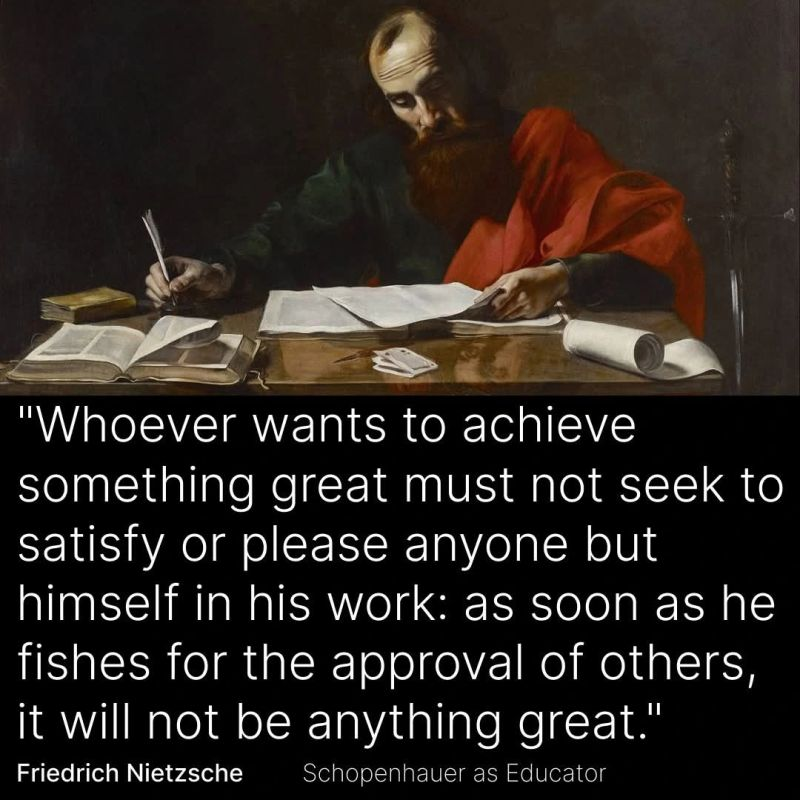
There is a line from Nietzsche's Schopenhauer as Educator that I have returned to more times than I can count. He writes that whoever wants to achieve something great must not seek to satisfy or please anyone but himself in his work, that as soon as he fishes for the approval of others, it will not be anything great.
People often read this as a statement about ambition. About greatness in the grand, public sense. I do not think that is what he was pointing at.
I think he was writing about self trust. The quiet, difficult, daily practice of coming home to what is actually alive in you rather than building your work around what will be well received.
Those are not the same thing. And the distance between them is where most of us live.
The Biology of Approval
Before we talk about what it takes to close that distance, it is worth understanding why it exists in the first place. Because the pull toward approval is not a character flaw. It is not weakness or lack of conviction. It is biology.
The nervous system is a social organ. Stephen Porges' polyvagal theory helps us understand that human beings are wired for co-regulation, that we literally regulate our internal states through connection with other nervous systems. For most of human history, belonging to the group meant survival. Exclusion meant death. The nervous system learned to read social acceptance as safety and social rejection as threat, and that learning is encoded deeply, beneath conscious thought, in the oldest parts of our biology.
So when you soften something true before you say it out loud, when you wait to see how something lands before you commit to it, when you edit the sharpest edges off your thinking before sharing it, your nervous system is doing exactly what it was designed to do. It is scanning for safety. It is protecting you from the threat of not belonging.
Understanding this does not make the pull disappear. But it changes the relationship to it. When you can name what is happening physiologically, you can work with it rather than be ruled by it. You can notice the edit happening in real time and ask whether it is wisdom or fear.
Those are different things and they require different responses.
What Lives Underneath
Nietzsche's concept of self overcoming was frequently misunderstood, and still is. It was not about domination or superiority. It was about the interior work of questioning the values you inherited and building a life from genuine conviction rather than inherited compliance. It was about becoming, as fully as possible, the specific person you actually are rather than the person the herd has shaped you to be.
In clinical work I see the cost of the alternative constantly. Not in dramatic ways but in the quiet, cumulative ways that chronic self suppression shows up in the body. The habitual override. The learned disconnection from internal signals. Gabor Maté writes about how the disconnection between what we feel and what we express is not a personal failing but a learned adaptation, a response to environments that made authentic expression unsafe. We learned to manage the presentation. We got very good at it. And then we wonder why something feels hollow even when everything looks fine from the outside.
What lives underneath that management is not a better, more disciplined version of yourself. It is your actual self. Your particular way of seeing. The gifts so specific to you that no one else could replicate them even if they tried. The work that feels less like performance and more like coming home.
That is what Nietzsche was pointing toward. Not a heroic, singular greatness. The quieter, more radical act of trusting what is genuinely yours.
Learning to Create From There
I want to be honest about the fact that I am still learning this. There is a version of this essay that would present self trust as something I have arrived at, a lesson I can now teach from a position of completion. That would be cleaner and more comfortable to write. It would also be less true.
What I know is that the pull toward approval does not go away simply because you understand its neurological origins. It softens with practice. It becomes more visible, which makes it more workable. But it does not disappear.
What changes is the relationship to it. The moment of noticing, when you catch yourself editing for reception rather than truth, becomes an invitation rather than a failure. It becomes the question: is this wisdom or is this fear? Is this genuine refinement or is this the nervous system doing what it was built to do?
Kristin Neff's research on self compassion is relevant here in a way that might seem surprising. She consistently finds that self compassion, the willingness to extend to yourself the quality of attention you would offer someone you love, reduces the shame response that keeps people cycling through the same patterns of self suppression. It is not indulgence. It is the precondition for honest work.
Because the harshest self critic is rarely the most honest creator. The person who can hold their own work with both rigor and warmth, who can see clearly without flinching and revise without self punishment, that person can create from somewhere real.
Nietzsche was not writing about the absence of self doubt. He was writing about the refusal to let approval seeking be the organizing principle of your work.
That is the practice. Not arriving somewhere beyond the pull. But choosing, again and again, to create from the place underneath it.
The place that is specifically, irreducibly yours.
With you in the work, Christina
Christina Hull, MSW, LCSW Trauma Therapist | Educator | Founder, Sage and Soothe Wellness christinalhull.com